
How Design Thinking & Strategy Inspired the AXIS Smart Chair
- Feb 22
- 3 min read

Challenge & Solution
Challenge —
Long hours spent seated amplify physical strain, cognitive decline, and Alzheimer’s disease—yet most workplace seating remains passive, static, and disconnected from the user’s well-being.
Traditional ergonomic chairs focus on posture alone, failing to address:
- Rising stress levels during critical decision moments
- Limited mobility within dynamic work environments
- Fragmented control between physical comfort, digital tools, and personal wellness
- The need for privacy, calm, and confidence amid complex, data-driven workflows
The opportunity was to rethink the chair not as furniture—but as an intelligent, responsive command center that actively supports performance, clarity, and resilience. Exploratory design research using a Star Wars Laser Cannon Mini Rig as an analog control system informed this shift, translating principles of rotation, modularity, and operator-centered feedback into a human-centered seating experience that adapts to both physical and cognitive demands.
Solution —
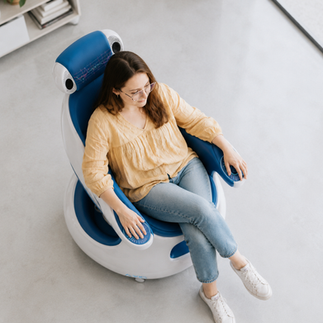
The AXIS smart chair is intelligent performance seating designed for modern professionals navigating constant disruption and high-stakes decisions. Built on the principle of rapid tactical response, AXIS anticipates, absorbs, and redirects stress at the moment—bridging the gap between ergonomics, 360° mobility, and smart workflow control. At its core, Digital Sensory Fabric continuously monitors physiological signals tied to well-being, enabling AXIS to sense rising stress and support clarity before performance is compromised.
AXIS Smart Chair began with a fundamental question: How do we design physical environments that actively support sustained thinking, decision-making, and wellbeing—not just comfort? In professions where people spend long hours seated while managing complex, high-stakes work, the chair is no longer a passive object. It’s part of the cognitive system.
From the outset, AXIS was developed through a research-driven, systems-thinking approach, treating the chair as an intersection of body, mind, space, and technology.

Research as Foundation
The design process combined qualitative user research with cross-domain analysis spanning ergonomics, human factors, and performance environments. Interviews and observational research with knowledge workers revealed consistent pain points: physical fatigue, loss of focus over time, and environments that restrict movement in the name of stability.
To challenge conventional furniture references, the research expanded into non-traditional domains—specifically battle tanks and military command vehicles. These environments are engineered for prolonged seated operation under extreme cognitive load, requiring operators to maintain awareness, control, and readiness for hours at a time. Despite their constraints, tanks prioritize stability, protection, reach, and efficient micro-movement—principles directly relevant to modern decision-makers.
Insights from this research informed AXIS’s command-center posture, reinforced side supports, and mobility logic—balancing grounded stability with the ability to pivot, rotate, and reposition without breaking focus.
Frameworks That Shaped the Design
Several frameworks guided the development of AXIS:
Human-Centered Design: Prioritizing lived experience over surface-level comfort, focusing on how the body and mind perform over extended periods.
Systems Thinking: Designing the chair as part of a broader work ecosystem—integrating posture, movement, orientation, and sensory input.
Embodied Cognition: Recognizing that physical alignment and motion directly influence clarity, stress, and decision quality.
Cognitive Load Theory: Applying visual restraint and controlled feedback to reduce distraction and support sustained attention.
From Object to Adaptive System
Rather than a static object, AXIS functions as an adaptive support system. Its 360° mobility enables natural micro-adjustments, while the form factor—part workstation, part cockpit—creates a sense of control and readiness. The Digital Sensory Fabric concept reinforces awareness without interruption, supporting self-regulation rather than surveillance.
The visual language draws from aerospace and armored-vehicle design not for spectacle, but for functional clarity—communicating preparedness, confidence, and calm authority.
Designing for Long-Term Performance
AXIS is grounded in a long-term view of human performance. Instead of optimizing for short-term comfort, it supports career-length wellbeing, acknowledging that posture, stress, and focus compound over time. In this way, ergonomics shift from a wellness feature to a strategic investment in people.
Ultimately, AXIS Smart Chair reflects a belief that design should quietly remove friction between people and their work. When environments are thoughtfully engineered, they fade into the background—allowing individuals to stay present, capable, and in control, even in moments that demand everything.
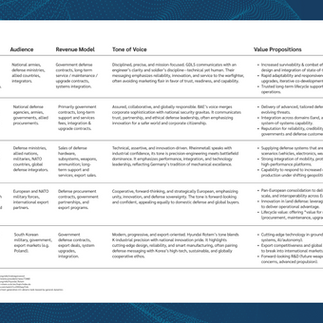
My research integrated typological analysis, persona evolution, competitive insight, and journey mapping to transform a Star Wars mobile laser cannon mini-rig into the inspiration for an intelligent performance smart chair. Reframed for a new target persona—professional who spend long hours seated. The work focused on reducing cognitive load, managing stress, enabling fluid mobility, and delivering discreet well-being support.






(Contact me to view the AXIS Smart Chair pitch deck.)